A business line of credit may help business owners manage cash flow gaps, unexpected expenses, and seasonal revenue swings. Business lines of credit are commercial lending products intended for business purposes only and are not consumer credit products. Unlike a term loan that provides one lump sum, a line of credit gives the business access to funds up to an approved credit limit. The business can draw what it needs, repay what it borrows, and draw again if the line is revolving and available.
That flexibility can be useful for local Indiana businesses with changing inventory needs, delayed receivables, busy seasons, or short-term working capital needs.
Springs Valley Bank & Trust provides business lines of credit tailored to local businesses, backed by local decision-making and advisors who understand the realities of rural Midwest commerce. The Bank can help business owners compare funding options and understand whether a credit line, term loan, or another business financing tool fits the need.
This guide covers:
- What is a business line of credit?
- How does a business line of credit work?
- Business line of credit vs. business loan.
- Types of business lines of credit.
- Business line of credit requirements.
- How to use a business line of credit wisely.
- Benefits of a business line of credit.
- How to apply for a business line of credit.
What is a Business Line of Credit?
A business line of credit is a flexible financing option that gives a business access to funds up to an approved limit.
The business does not need to use the full amount at once. It can borrow only what it needs, subject to the terms of the line.

Definition and Core Function
The core function of a business line of credit is short-term access to capital.
A business may use it to cover timing gaps between expenses and revenue. It may also use it for inventory, payroll timing, seasonal supplies, or unexpected operating costs.
A line of credit is often best for needs that come and go. It is not always the best fit for large, long-term purchases that may need structured repayment over several years.
How It Differs From a Credit Card
A business line of credit and a business credit card both provide access to borrowed funds. But they are not the same.
A credit card is often used for smaller purchases, travel, subscriptions, or routine expenses. A line of credit is often used for larger working capital needs, cash flow management, inventory, receivables, or seasonal expenses.
A business line of credit may also have different terms, collateral requirements, draw methods, and repayment expectations.
Who Uses a Business Line of Credit?
Many types of businesses use credit lines.
These may include:
- Retail stores managing seasonal inventory
- Contractors waiting for customer payments
- Farms and agribusinesses with seasonal costs
- Service companies covering payroll timing
- Restaurants and hospitality businesses managing supply costs
- Professional firms with delayed receivables
- Local businesses preparing for busy months
A line of credit can be useful when the business has a clear short-term need and a realistic repayment source.
How Does a Business Line of Credit Work?
How does a business line of credit work? The lender may approve a maximum credit limit based on underwriting criteria. The business can draw funds as needed, repay borrowed amounts, and, if the line is revolving, borrow again within the approved terms.
The details depend on the lender, credit approval, business qualifications, and loan agreement. Approval, credit limits, and terms are determined based on the applicant’s financial condition, collateral, and creditworthiness.
The Draw Period and Repayment Cycle
The draw period is the time when the business can access funds.
During that time, the business may borrow up to the approved limit. The business then repays according to the loan agreement. Payments may include interest, principal, fees, or other required amounts.
If the line is revolving, repaid principal may become available to borrow again. If the line is non-revolving, repaid funds may not become available again.
Variable vs Fixed Interest Rates
Business lines of credit may have variable or fixed interest rates, depending on the product and lender.
A variable rate can change over time based on the loan agreement and market conditions. A fixed rate stays the same for a defined period or term, subject to the agreement.
Rates, margins, and adjustments may vary and may increase payment amounts over time. Borrowers should review loan documentation for full details on rate calculations, adjustments and whether any fees apply.
Credit Limit Increases and Renewals
A business line of credit may be reviewed or renewed periodically. The lender may review financial statements, repayment history, credit use, collateral, and business performance.
A credit limit increase may be possible if the business grows, improves cash flow, adds collateral, or shows stronger repayment ability. Approval is not automatic.
Business owners should keep financial records current so renewal conversations are easier.
All loans are subject to credit approval. Terms, conditions, and interest rates may vary based on creditworthiness, qualifications, loan structure, and market conditions.
Business Line of Credit vs Business Loan
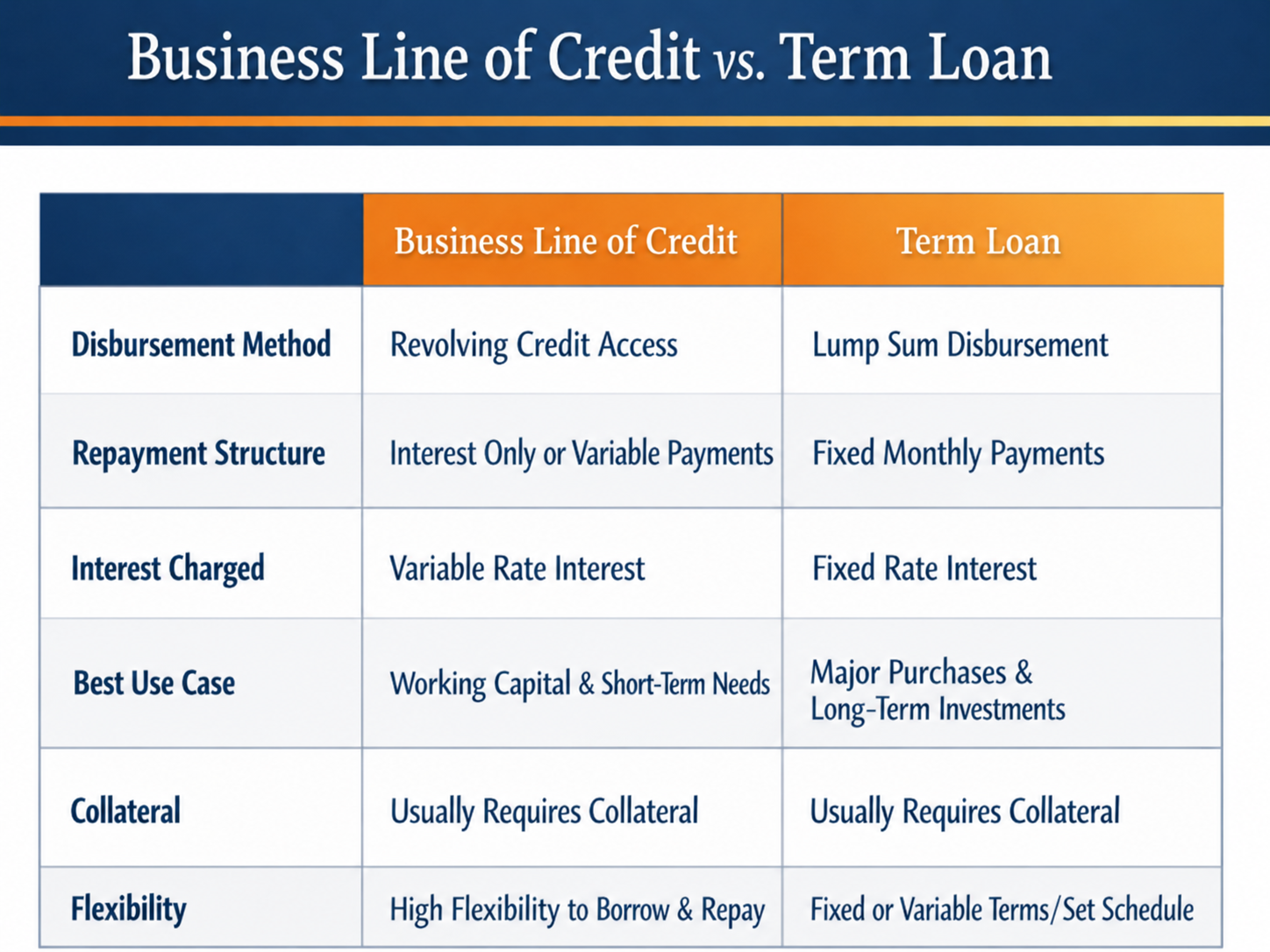
A business line of credit vs. a business loan is a common comparison. Both can help a business access capital, but they are built for different needs.
A line of credit is flexible. A term loan is structured.
Key Structural Differences
A business loan usually provides a lump sum upfront. The business repays it through scheduled payments over a set term.
A business line of credit provides access to a credit limit. The business draws funds when needed and pays based on what it borrows.
That makes a line of credit useful for recurring short-term needs. A term loan may be better for one-time investments, such as equipment, vehicles, expansion, or real estate.
When to Use a Line of Credit vs a Term Loan
A business line of credit may fit when the business needs to:
- Manage cash flow gaps
- Buy seasonal inventory
- Cover short-term payroll timing
- Handle delayed receivables
- Respond to unexpected operating expenses
- Prepare for busy periods
A term loan may fit when the business needs to:
- Buy equipment
- Purchase or improve property
- Fund a major expansion
- Refinance longer-term debt
- Finance a large project with a clear cost
Springs Valley can help business owners compare commercial business loans and credit line options.
Cost Comparison: Interest and Fees
Costs can vary by lender, product, credit profile, collateral, and loan terms.
A business line of credit may charge interest only on the amount borrowed, plus any applicable fees. A term loan usually charges interest on the full loan balance after funds are disbursed.
Business owners should review the full cost. That includes interest rates, origination fees, renewal fees, unused line fees, collateral costs, closing costs, and repayment terms. Fees and costs may be assessed at origination, during the term, or at renewal. Not all applicants will qualify for the lowest rates or most favorable terms.
The lowest rate does not always mean the best fit. The structure should match the business needs.
Types of Business Lines of Credit
There are several types of business lines of credit. Each has its own structure, risk, and best use.
Business owners should ask what type of line is being offered before signing loan documents.
Secured Business Lines of Credit
A secured business line of credit requires collateral. Collateral may include accounts receivable, inventory, equipment, business assets, or other approved property.
Secured lines may allow higher credit limits or different terms because the lender has collateral supporting the request.
The business owner should understand what assets are pledged and what happens if the line is not repaid.
Unsecured Business Lines of Credit
An unsecured business line of credit does not require specific collateral in the same way a secured line does.
Because the lender takes on more risk, unsecured lines may have lower limits, higher rates, stronger qualification requirements, or personal guarantees.
This option may fit some established businesses with strong credit and financial performance.
Revolving vs Non-Revolving Lines
Revolving credit for businesses allows the borrower to draw, repay, and draw again during the approved period.
Non-revolving lines may allow draws up to the limit, but repaid amounts do not become available again.
Business owners should confirm whether the line is revolving or non-revolving. That detail affects how the business can use the funds over time.
SBA CAPLines of Credit
SBA CAPLines of credit are part of the SBA 7(a) loan program. The SBA says CAPLines are designed to help small businesses meet short-term and cyclical working capital needs through specific line of credit options. SBA’s materials identify CAPLines such as Seasonal, Contract, Builders, and Working Capital lines.
SBA loans are made by approved lenders and backed by SBA guarantees. They may involve more documentation and program-specific rules than a conventional business line of credit.
Business owners should ask whether an SBA-backed line is available and whether it fits the business need.
Eligibility, terms, and approval are subject to SBA program requirements and lender underwriting. Not all applicants will qualify for SBA programs.
Business Line of Credit Requirements
Business line of credit requirements vary by lender and product. A bank will review the business, the owners, the requested limit, and the purpose of the funds.
The stronger the business profile, the more options may be available.
Credit Score and Business History
Lenders often review both business and personal credit, especially for small businesses.
They may also review time in business, repayment history, ownership structure, and industry. A newer business may face more review because it has less operating history.
A lower credit score does not always end the conversation, but it may affect approval, collateral needs, limits, or pricing.
Revenue Thresholds and Financial Statements
Lenders review revenue to understand business activity and repayment ability.
A business may need to provide financial statements, tax returns, bank statements, accounts receivable reports, inventory reports, or other records.
The goal is to show that the business can use the credit line responsibly and repay draws on schedule.
Collateral Requirements for Secured Lines
Secured lines may require collateral.
Collateral can include business assets such as receivables, inventory, equipment, vehicles, or real estate. The lender may also request appraisals, lien searches, insurance, or other documentation.
Business owners should understand collateral requirements before accepting the line.
How to Use a Business Line of Credit Wisely
A business line of credit is useful when it is tied to a clear plan. It should not be treated as extra income.
The best use is short-term funding with a defined repayment source.
Managing Cash Flow Gaps
Cash flow gaps happen when expenses arrive before revenue.
For example, a business may need to pay suppliers before customers pay invoices. A line of credit can help cover that timing gap.
The repayment plan should be tied to expected receivables, seasonal revenue, or another realistic cash source.
Inventory Purchasing and Seasonal Prep
Seasonal businesses may use a line of credit to buy inventory, supplies, or materials before the busy period begins.
This can help businesses prepare without draining operating cash.
The business should track inventory carefully and avoid borrowing more than the expected sales cycle can support.
What Not to Use a Credit Line For
A business line of credit is usually not the best fit for every expense.
Business owners should be cautious about using a credit line for the following:
- Long-term equipment purchases that need a term loan
- Real estate purchases
- Ongoing losses with no repayment plan
- Owner draws not tied to business performance
- Large projects without clear costs
- Debt consolidation without a cash flow plan
A credit line should support working capital, not hide deeper financial issues.
Benefits of a Business Line of Credit
The benefits of a business line of credit may come from flexibility, access, and timing. Benefits depend on individual business circumstances, product structure, and responsible use.
For many small businesses, the biggest value is having funds available before a need becomes urgent.
On-Demand Access to Capital
A business line of credit gives approved businesses access to capital when needed, subject to the loan terms.
This can help owners respond quickly to short-term needs. It may reduce the need to apply for a new loan every time a cash flow issue appears.
That access can be especially useful for businesses with predictable seasonal changes.
Building Business Credit History
Responsible use of a line of credit may help a business build a stronger borrowing profile over time.
The business should make payments on time, avoid overextending the line, and keep records organized.
A stronger credit history may help the business seek larger financing later, although future approval is never guaranteed.
Credit reporting practices vary, and not all business credit activity is reported to all credit bureaus.
Flexibility That Term Loans Cannot Provide
A term loan is helpful when the business needs a fixed amount for a fixed purpose.
A line of credit provides more flexibility because the business can draw what it needs when it needs it.
That makes it useful for working capital, inventory, short-term gaps, and recurring seasonal needs.
How to Apply for a Business Line of Credit
Business owners asking how to apply for a business line of credit should start by reviewing their business finances.
A prepared applicant can have a more productive lender conversation.
Step 1, Review Your Business Credit Profile
The first step is reviewing business and personal credit.
Business owners should check for errors, late payments, high debt balances, or unresolved issues. They should also understand whether the business has its own credit profile.
A lender can explain what information will be reviewed during the application.
Step 2, Gather Financial Documents
Common documents may include:
- Business tax returns
- Personal tax returns for owners
- Profit and loss statements
- Balance sheet
- Bank statements
- Accounts receivable aging report
- Inventory report
- Debt schedule
- Ownership documents
- Business plan or funding explanation
The exact list depends on the business, requested limit, collateral, and lender requirements.
Step 3, Compare Lenders and Terms
Business owners should compare more than the interest rate.
They should review:
- Credit limit
- Draw process
- Repayment terms
- Renewal schedule
- Collateral requirements
- Fees
- Rate type
- Personal guarantee requirements
- Local support and communication
A line of credit should fit how the business actually operates.
Step 4, Submit Application With Springs Valley
Springs Valley Bank & Trust works with local business owners to review credit needs and financing options.
Customers can contact Springs Valley Bank & Trust or visit any Springs Valley branch to start a business lending conversation. The bank can help compare a line of credit with commercial business loans, agricultural financing, digital business banking tools, and other resources that may support business cash flow.
For broader planning, business owners may also review business checking accounts, business savings accounts, Springs Valley Bank FAQs, and Springs Valley loan calculator.
Business lines of credit are commercial lending products intended for business use only. All extensions of credit are subject to underwriting, credit approval, and satisfactory documentation. Terms, rates, fees, and eligibility requirements vary by applicant and product type. Collateral may be required. Personal guarantees may be required. Contact Springs Valley Bank & Trust for complete product details and disclosures.
FAQs
This content is for informational purposes only and does not constitute financial, tax, or legal advice. Consult your own advisors regarding your individual situation.
Springs Valley Bank & Trust Company is an Equal Housing Lender and Member FDIC.
What is a Business Line of Credit And How Is It Different From a Business Loan?
A business line of credit is a credit facility that allows a business to borrow, repay, and, if revolving, borrow again up to an approved credit limit.
A business loan usually provides a lump sum upfront that is repaid in scheduled payments over a set term. A credit line is often better for short-term working capital. A term loan is often better for one-time purchases or long-term projects.
What Are The Requirements For a Business Line of Credit?
Requirements vary by lender and product.
A lender may review credit history, time in business, revenue, financial statements, cash flow, collateral, owner information, and the purpose of the line. Secured business lines of credit may require business assets, receivables, inventory, equipment, or other collateral.
What Can I Use a Business Line of Credit For?
A business line of credit is often used for cash flow gaps, seasonal inventory, payroll timing, delayed receivables, supplier payments, and short-term operating needs.
It is usually not the best fit for long-term asset purchases or major expansion projects that may need a term loan.
Is a Secured or Unsecured Business Line of Credit Better?
The better option depends on the business.
A secured business line of credit may offer different limits or terms because it is backed by collateral. An unsecured line may not require specific collateral, but it may have stricter qualification standards, lower limits, or different pricing.
What is an SBA CAPLine of Credit?
An SBA CAPLine is a line of credit option under the SBA 7(a) program.
SBA CAPLines are intended to help small businesses meet short-term and cyclical working capital needs. SBA materials identify CAPLine options such as seasonal, contract, builder, and working capital lines.
How Long Does It Take to Get a Business Line of Credit Approved?
Approval timing varies based on the lender, application complexity, financial records, collateral, requested limit, and whether SBA or other program review is involved.
Complete documents can help the process move more smoothly. Local review may also help business owners get clearer communication during the process.
Can a New Business Get a Line of Credit?
A new business may have fewer options because lenders often rely on business history and revenue.
Some newer businesses may qualify with strong owner credit, collateral, outside income, or a clear business plan. Others may need to build operating history before qualifying for a larger line.
How Does a Business Line of Credit Help Build Business Credit?
Responsible use may help a business show repayment history over time.
Business owners should make payments on time, keep balances manageable, and use the line for planned business needs. Future financing approval depends on the business’s full financial profile and lender requirements.
A business line of credit can help local businesses manage short-term cash flow, seasonal inventory, delayed receivables, and unexpected operating needs. The right structure depends on the business’s revenue, credit profile, collateral, and repayment plan. Springs Valley Bank & Trust can help business owners compare a business line of credit with other funding options and choose a path that fits the business. Customers can contact Springs Valley Bank & Trust or visit any Springs Valley branch to start the conversation.