How to plan for retirement is one of the most important financial questions a customer can ask. Retirement is not a single event. It is the result of years of decisions about saving, investing, debt, income, taxes, healthcare, and family goals.
Many people know they should save for retirement. Fewer have a written plan. That gap can create stress as retirement gets closer.
Springs Valley Bank & Trust helps individuals and families think through retirement with local support and practical guidance. Springs Valley’s Financial Advisory Group can help customers review IRAs, employer retirement plans, income needs, Social Security timing, and legacy preparation.
This guide explains how to plan for retirement step by step, how much customers may need to retire, the types of retirement accounts available, retirement income strategies, common retirement planning mistakes, and when working with a retirement planner may help. It is intended for general educational purposes only and should not be relied upon as individualized financial, investment, tax, legal, or retirement-plan advice.
Investment and advisory services are not deposits; not insured by the FDIC; not a deposit or other obligation of, or guaranteed by, Springs Valley Bank & Trust Company; not insured by any federal government agency; and may lose value, including possible loss of principal. Investment, insurance, and advisory products and services are offered through third-party registered representatives and/or investment adviser representatives, as applicable, and are not bank deposits or obligations of Springs Valley Bank & Trust Company.
How to Plan for Retirement Step by Step
A retirement plan gives customers a path. It helps them understand where they are today, where they want to go, and what choices may help close the gap.
A strong retirement plan usually includes:
- Current savings
- Employer retirement accounts
- IRAs
- Social Security estimates
- Expected expenses
- Healthcare planning
- Debt review
- Tax planning
- Income withdrawal planning
- Estate and legacy goals
The exact plan will look different for every household. A farm family, a teacher, a small business owner, a healthcare worker, and a recent graduate may all need different strategies.
This content is provided for general informational and educational purposes only and should not be considered individualized financial, investment, tax, or legal advice. The information presented does not take into account the specific financial circumstances, objectives, or risk tolerance of any individual.
When to Start Planning for Retirement
The best time to start planning for retirement is as early as possible. Early planning gives savings and investments more time to grow. It also gives customers more time to adjust if their income, expenses, or goals change.
That does not mean customers who start later are out of options. Customers in their 40s, 50s, or 60s can still make important progress. They may need a more focused strategy, but planning can still help.
The main goal is to move from guessing toward a more informed understanding. Customers should review how much they have saved, how their accounts are invested, when they may want to retire, and what income sources they expect to use.
The Difference Between Saving and Planning
Saving is putting money aside. Planning is deciding how those savings will support a future lifestyle.
A customer may save consistently for years but still have questions:
- Will the money last?
- Which account should be used first?
- How will taxes affect withdrawals?
- What happens if healthcare costs rise?
- Should Social Security start early or later?
- How will assets pass to family?
That is where planning matters. Retirement planning connects savings, income, investments, taxes, healthcare, and legacy goals into one strategy.
Springs Valley’s Financial Advisory Services can help customers move beyond general rules and review their own financial picture. Any recommendations should be based on the customer’s personal circumstances, objectives, risk tolerance, and applicable tax/legal considerations.
How Much Do You Need to Retire?
How much do you need to retire? The answer depends on the client’s lifestyle, health, debt, retirement age, family needs, income sources, and comfort with risk.
There is no single number that works for everyone. A client who owns a home with low debt may need a different plan than a client who expects to travel, support family, or retire before Medicare eligibility.
What is the 4 Percent Rule for Retirement?
The 4 percent rule for retirement is a common guideline. It suggests that a retiree may withdraw a set percentage from retirement savings in the first year, then adjust future withdrawals over time.
It is only a guideline. It is not a guarantee.
Market performance, inflation, taxes, healthcare costs, and life expectancy can all affect whether a withdrawal plan works. Customers should not rely on a general rule without reviewing their own accounts, expenses, and risk tolerance.
A retirement planner can help test different withdrawal approaches and adjust the plan as conditions change. Results are hypothetical and depend on assumptions such as market performance, inflation, taxes, expenses, and longevity.
Estimating Your Annual Retirement Expenses
Retirement expenses usually fall into several categories:
- Housing
- Utilities
- Food
- Transportation
- Insurance
- Healthcare
- Taxes
- Debt payments
- Family support
- Travel and hobbies
- Charitable giving
- Home maintenance
Customers should start by reviewing current expenses. Then they should decide which expenses may change in retirement.
Some costs may go down. Work clothing, commuting, or payroll taxes may decrease. Other costs may rise. Healthcare, home repairs, insurance, and long-term care can become larger concerns.
A retirement budget does not need to be perfect at first. It needs to be honest enough to guide decisions.
Healthcare, Inflation, and Longevity Considerations
Healthcare is one of the hardest retirement expenses to estimate. Costs can vary based on health, insurance, prescriptions, long-term care needs, and retirement age.
Inflation also matters. A retirement plan has to account for rising costs over time. A budget that works in the first year of retirement may not work the same way later.
Longevity is another key factor. Many retirees need income that can last for decades. That means the plan should balance current spending with long-term sustainability.
Customers should review retirement plans regularly. A plan created years ago may need updates as markets, tax rules, family needs, and health change. Customers should consult qualified tax, legal, insurance, and financial professionals before making decisions based on changes in laws, benefits, or personal circumstances.
Different Types of Retirement Accounts Explained
The main types of retirement savings and investment accounts may include employer-sponsored plans, Traditional and Roth IRAs, self-employed retirement plans, and taxable investment accounts. Account availability, eligibility, tax treatment, contribution limits, and withdrawal rules vary and may change.
Each account type has its own rules. Some offer tax benefits now. Others may offer tax benefits later. Some are tied to an employer. Others are opened individually.
Investment and advisory services are not deposits; not insured by the FDIC; not a deposit or other obligation of, or guaranteed by, Springs Valley Bank & Trust Company; not insured by any federal government agency; and may lose value, including possible loss of principal.
401(k) and 403(b) Plans
A 401(k) plan is an employer-sponsored retirement plan often used by private employers. A 403(b) plan is similar but is commonly offered by schools, nonprofits, and certain public organizations.
These plans allow employees to contribute part of their pay to retirement. Some employers may offer matching contributions. Customers should understand the plan’s investment options, vesting rules, fees, and contribution limits.
The IRS updates retirement plan contribution limits, so customers should check current limits each year or ask a qualified advisor. Because limits and eligibility rules change, customers should confirm the current limits before contributing.
Traditional IRA vs. Roth IRA
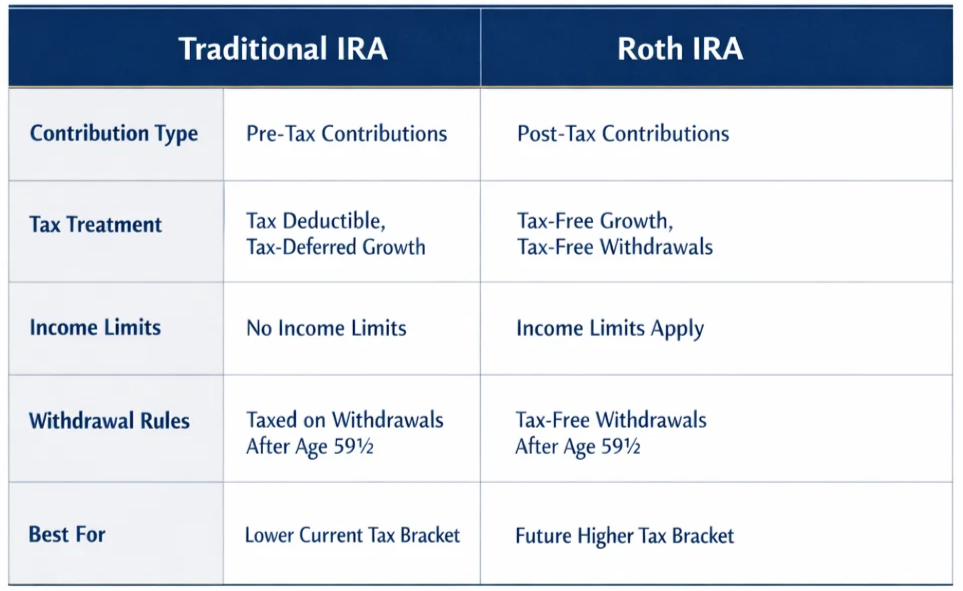
Traditional IRA vs. Roth IRA decisions usually come down to tax timing.
A Traditional IRA may allow deductible contributions, depending on income and workplace retirement plan coverage. Withdrawals of deductible contributions and earnings are generally taxable. Early withdrawals may also be subject to additional tax unless an exception applies. Customers should consult current IRS resources and a qualified tax advisor before acting.
A Roth IRA works differently. Contributions are not deductible. Qualified withdrawals may be tax-free if IRS rules are met. The IRS explains that Roth IRA earnings may avoid tax when the distribution is qualified.
Neither option is automatically better for every customer. The right choice depends on income, tax situation, retirement timeline, and future expectations.
SEP IRA for the Self-Employed
A SEP IRA may be useful for self-employed workers and some small business owners. It allows business owners to make retirement contributions for themselves and, when applicable, eligible employees.
This can be important for contractors, farm operators, family businesses, and self-employed professionals.
Business owners should review retirement plan options with tax and financial advisors.
Social Security as Part of Your Income Plan
Social Security can be an important part of retirement income, but it should usually be viewed as one piece of the plan.
The age a customer claims benefits can affect the monthly amount. Benefits may be reduced when claimed before full retirement age, and delayed retirement credits may increase benefits for customers who wait beyond full retirement age, subject to Social Security rules.
Customers should review their Social Security estimate through official SSA tools. They should also consider how Social Security fits with pension income, retirement accounts, savings, part-time work, taxes, healthcare costs, and required withdrawals, if applicable.
Retirement Income Strategies
Retirement income strategies help customers turn savings into usable income.
This is a major shift. During working years, the main focus is often saving. During retirement, the focus becomes drawing income in a way that supports daily life and helps savings last.
Creating a Sustainable Withdrawal Schedule
A sustainable withdrawal schedule considers:
- Expected expenses
- Retirement account balances
- Investment risk
- Tax impact
- Social Security timing
- Pension income, if available
- Required minimum distributions, when applicable
- Emergency reserves
A withdrawal plan should be flexible. Markets may change. Health needs may change. Family responsibilities may change.
Customers should avoid setting a withdrawal plan once and never reviewing it. A more flexible approach is to revisit the plan regularly and make adjustments as needed. Withdrawal strategies should be reviewed with qualified financial and tax professionals because tax treatment and account rules vary.
Balancing Taxable and Tax-Deferred Income
Retirement income may come from several account types. Some may be taxable. Some may be tax-deferred. Some may be tax-free if specific rules are met.
The order of withdrawals can affect taxes, cash flow, and long-term account value.
For example, customers may have:
- Traditional retirement accounts
- Roth accounts
- Taxable investment accounts
- Bank savings
- Pension income
- Social Security income
Each source has different tax treatment. Customers should work with qualified tax and financial advisors before making withdrawal decisions.
Springs Valley’s Financial Advisory Group can work with customers and their tax professionals to help review the differences among income sources. Springs Valley Bank & Trust Company does not provide tax or legal advice.
Common Retirement Planning Mistakes
Retirement planning mistakes can be costly because time is hard to replace.
The good news is that many mistakes are avoidable when customers review their plan early and update it often.
Starting Too Late or Saving Too Little
One common mistake is waiting to plan. Customers may delay because retirement feels far away or because the topic feels stressful.
Waiting can limit options. It may require larger contributions later or a later retirement date.
Customers who start late should not assume the effort is pointless. A focused plan may still improve retirement readiness. Potential steps may include increasing contributions, reducing debt, reviewing spending, delaying retirement, or working part time longer than planned, depending on the customer’s circumstances and ability to do so.
Ignoring Healthcare Costs and Long-Term Care
Healthcare can affect retirement more than many customers expect.
Planning should consider insurance, prescriptions, dental care, vision care, long-term care, and potential support needs. Customers should also think about what happens if one spouse or partner needs care before the other.
Long-term care planning is not only a medical issue. It can affect savings, family members, housing, and estate plans.
Customers should review these topics before there is a crisis.
Withdrawing Early and Losing Compound Growth
Early withdrawals from retirement accounts can reduce long-term growth. They may also create taxes and penalties, depending on the account and the customer’s age.
IRA distributions are generally included in taxable income and may be subject to additional tax when taken before age 59½ unless an exception applies. Customers should review current IRS guidance and consult a qualified tax advisor before taking early withdrawals. A short-term cash need can have long-term retirement consequences.
Building the Foundation in Your 30s
The 30s are often a foundation-building decade. Customers may be growing careers, buying homes, paying student loans, starting families, or building businesses.
Retirement may not feel urgent, but the habits built in this decade can matter later.
Important steps may include:
- Contributing to an employer retirement plan
- Opening an IRA, when appropriate
- Building emergency savings
- Paying down high-interest debt
- Keeping spending in line with income
- Reviewing insurance needs
- Starting basic estate planning
Planning for Retirement in Your 40s
Planning for retirement in your 40s often becomes more serious. Customers may have higher income than they had earlier in life, but they may also have more responsibilities.
That can include a mortgage, children, aging parents, business ownership, or college costs.
The 40s can be a good time to review retirement savings, debt, insurance, investment risk, and estate documents.
Catch-Up Strategies for Your 50s
The 50s are often a time to get more specific.
Customers may need to estimate retirement expenses, review Social Security timing, increase retirement contributions, reduce debt, and decide when they want to stop full-time work.
IRS catch-up contribution rules may allow eligible workers who meet applicable age and eligibility requirements to contribute more to some retirement accounts. Contribution limits and eligibility requirements can change, so customers should review current IRS guidance and speak with a qualified advisor.
Customers should also review investment risk. A portfolio that worked well earlier in life may need to be adjusted as retirement gets closer.
Working With a Retirement Planner
Working with a retirement planner can help customers turn scattered account information into a clear plan.
A retirement planner can help organize financial details, explain account options, and review income strategies. The scope of services, registrations, and compensation should be reviewed before engaging any financial professional.
What a Financial Advisor Brings to Your Plan
A financial advisor can help customers review the following:
- Retirement goals
- Savings rate
- Investment allocation
- IRA and employer plan options
- Social Security timing
- Income withdrawal strategies
- Tax considerations
- Legacy goals
- Risk tolerance
A financial advisor does not remove uncertainty. Markets, laws, health, and family circumstances can change.
But an advisor can help customers prepare, review choices, and adjust the plan over time. An advisor cannot guarantee investment performance, income, tax results, or that a retirement plan will meet all future needs. Investment and advisory services are not deposits; not insured by the FDIC; not a deposit or other obligation of, or guaranteed by, Springs Valley Bank & Trust Company; not insured by any federal government agency; and may lose value, including possible loss of principal.
How Springs Valley’s Financial Advisory Group Helps
Springs Valley’s Financial Advisory Group provides retirement planning support for individuals and families across Indiana and the rural Midwest. Availability of services, professionals, and products may vary.
That support may include conversations about IRAs, employer retirement plans, retirement income strategies, Social Security timing, legacy planning, and coordination with other financial goals.
The goal is not to use a one-size-fits-all plan. It is to help customers understand their options and make informed decisions based on their own situation. Any investment recommendations should be made only after review of the customer’s financial status, tax status, investment objectives, risk tolerance, and other relevant information.
For customers asking how to plan for retirement, the best next step is to start with a clear review of income, savings, expenses, debt, account types, and future goals. Springs Valley Bank & Trust can help customers begin that conversation with local support and practical financial guidance.
Contact Springs Valley Bank & Trust to schedule a conversation with Springs Valley’s Financial Advisory Group.
Investment and advisory services are not deposits; not insured by the FDIC; not a deposit or other obligation of, or guaranteed by, Springs Valley Bank & Trust Company; not insured by any federal government agency; and may lose value, including possible loss of principal.
This content is provided for general informational and educational purposes only and should not be considered individualized financial, investment, tax, or legal advice. The information presented does not take into account the specific financial circumstances, objectives, or risk tolerance of any individual.
FAQs
How to Plan for Retirement If You Are Starting Late?
Starting late does not mean planning is pointless. Customers in their 40s and 50s may still improve retirement readiness by reviewing spending, increasing savings when possible, reducing debt, and evaluating retirement timing.
Eligible workers may also have access to catch-up contribution options under IRS rules. Because limits and eligibility can change, customers should review current IRS guidance and speak with a qualified advisor.
How Much Do You Need to Retire Comfortably?
The amount needed to retire comfortably depends on lifestyle, health, debt, housing costs, family needs, Social Security income, and retirement age.
General benchmarks can help start the conversation, but they should not replace a personal plan developed after reviewing the customer’s specific circumstances, goals, risk tolerance, and tax considerations. A customer’s retirement target should be based on expected expenses, income sources, taxes, inflation, healthcare needs, and risk tolerance.
What is the Difference Between a 401(k) and an IRA?
A 401(k) is an employer-sponsored retirement plan. An IRA is an individual retirement account opened outside an employer plan.
A 401(k) may include employer contributions, depending on the plan. An IRA may give customers more control over account providers and investment options. Both can offer tax advantages, but rules vary by account type.
What is the Best Age to Start Planning for Retirement?
The best age to start planning for retirement is as early as possible.
Early planning gives customers more time to save, invest, review risk, and adjust goals. Customers who begin later can still make progress, but they may need a more focused plan.
What is the 4 Percent Rule for Retirement Withdrawals?
The 4 percent rule is a retirement withdrawal guideline. It is often used as a starting point for thinking about how much a retiree may withdraw from savings each year.
It is not a guarantee. Actual withdrawal decisions should consider market conditions, taxes, inflation, healthcare costs, and life expectancy.
Should Customers Use a Traditional IRA or a Roth IRA?
Traditional IRAs and Roth IRAs have different tax treatment.
Traditional IRA contributions may be deductible, depending on IRS rules. Withdrawals of deductible contributions and earnings are generally taxable. Roth IRA contributions are not deductible, but qualified withdrawals may be tax-free if IRS requirements are met.
Customers should speak with a qualified tax or financial advisor before choosing an account or making contributions, conversions, or withdrawals.
What is a Catch-Up Contribution?
A catch-up contribution is an additional retirement plan contribution allowed for eligible workers who meet certain age requirements.
Catch-up rules and limits vary by account type and may change over time. Customers should review current IRS guidance or speak with a qualified advisor before making decisions.
How Does Social Security Factor Into a Retirement Plan?
Social Security may provide part of a customer’s retirement income. The age a customer claims benefits can affect the monthly benefit amount.
Customers should review their official Social Security estimate and consider how benefits fit with retirement accounts, pension income, savings, part-time work, and expenses. Springs Valley’s Financial Advisory Group can help customers review Social Security as part of a broader retirement income strategy. Social Security claiming decisions should be evaluated using official SSA information and the customer’s personal income, tax, work, health, and family circumstances.