How to use home equity is an important question for many homeowners in rural southwest Indiana. A home may be a customer’s largest financial asset. Used carefully, that equity may help fund home improvements, consolidate debt, or cover major expenses.
Home equity is the part of a home’s value the homeowner owns after subtracting what is still owed on the mortgage. As payments are made and the home’s value changes, equity may grow.
Springs Valley Bank & Trust offers home equity loans and home equity lines of credit to qualified applicants, subject to product availability and applicable underwriting requirements. Springs Valley’s lending team may provide local guidance, as requested, for homeowners considering their borrowing options.
All loan programs are subject to credit approval, underwriting requirements, and program eligibility. Not all applicants will qualify. Terms, conditions, and availability may vary based on borrower qualifications and property characteristics. Property insurance is required on property securing a home equity loan or HELOC. Flood insurance may also be required when applicable.
This guide explains home equity, common uses for home equity, the differences between a home equity loan and HELOC, factors that may affect how much a homeowner may be able to borrow, potential risks, rural property considerations, and the application process.
What is Home Equity?
Home equity is the difference between a home’s current market value and the amount still owed on loans secured by the home.
A homeowner may build equity in several ways. Mortgage payments may reduce the loan balance. Property values may increase over time. Home improvements may also affect value, depending on the project and the local market.
Home equity can be useful, but it is not cash sitting in an account. To access it, a homeowner usually needs to borrow against the property.
How Payments and Appreciation Build Equity
Each mortgage payment may help build equity when part of the payment goes toward principal. Principal is the amount borrowed, not the interest cost.
Home value may also affect equity. If a home’s market value rises, the homeowner may have more equity. If the market value falls, equity may decrease.
Home improvements may sometimes support property value, but no project guarantees a higher appraisal. Rural property values may also depend on land, location, outbuildings, access, comparable sales, and local demand.
That is why local lending guidance matters. A lender familiar with rural Indiana property may help homeowners understand how the appraisal process may affect a home equity request.
Calculating Your Current Home Equity
Calculating current home equity starts with a simple formula. Subtract the outstanding mortgage balance from the home’s current market value.
The result is estimated equity.
That estimate is not the same as the amount a homeowner may borrow. Lenders review appraised value, existing mortgage debt, credit history, income, debt obligations, and loan guidelines.
A professional appraisal may be required during the application process. Online estimates may be useful for a rough starting point, but they may not reflect the final value used by the lender.
Best Uses for Home Equity
Homeowners may consider home equity for a variety of expenses, but whether a particular use is appropriate depends on the borrower’s circumstances, available alternatives, costs, and ability to repay. Since the home secures the loan, the borrowing decision should be made carefully.
Home equity may make sense when the borrower has a clear purpose, a realistic repayment plan, and enough income to manage the loan.
Using Home Equity for Home Improvements
Using home equity for home improvements is one of the most common reasons homeowners consider a home equity loan or HELOC.
Projects may include repairs, renovations, accessibility updates, energy-related improvements, or added living space. For rural homeowners, improvements may also involve wells, septic systems, driveways, garages, barns, or outbuildings.
A home equity loan may fit a project with a defined cost and timeline. A HELOC may fit ongoing projects where the homeowner expects to draw funds in stages.
Before borrowing, homeowners should get written estimates, review project priorities, and decide whether the improvement supports long-term household needs.
Home Equity for Debt Consolidation
Home equity for debt consolidation may help some borrowers simplify payments or reduce interest costs. But it also comes with serious risk.
Credit card debt and some personal loans are unsecured. A home equity loan or HELOC is secured by the home. That means the homeowner is moving debt into a loan tied to the property.
This may make sense only when the borrower has a clear repayment plan and avoids adding new high-interest debt afterward.
Debt consolidation should not be used as a short-term fix for ongoing overspending. It should be part of a broader budget plan.
Education Expenses and Major Life Costs
Some homeowners consider home equity for education expenses, medical bills, major repairs, or family needs.
These uses require caution. A home equity loan may spread repayment over time, but the home is still collateral.
Families should compare options before borrowing. Depending on the need, other solutions may be more appropriate.
Springs Valley customers may also review Springs Valley Bank FAQs or Springs Valley Calculators for additional planning resources.
Home Equity Loan vs HELOC
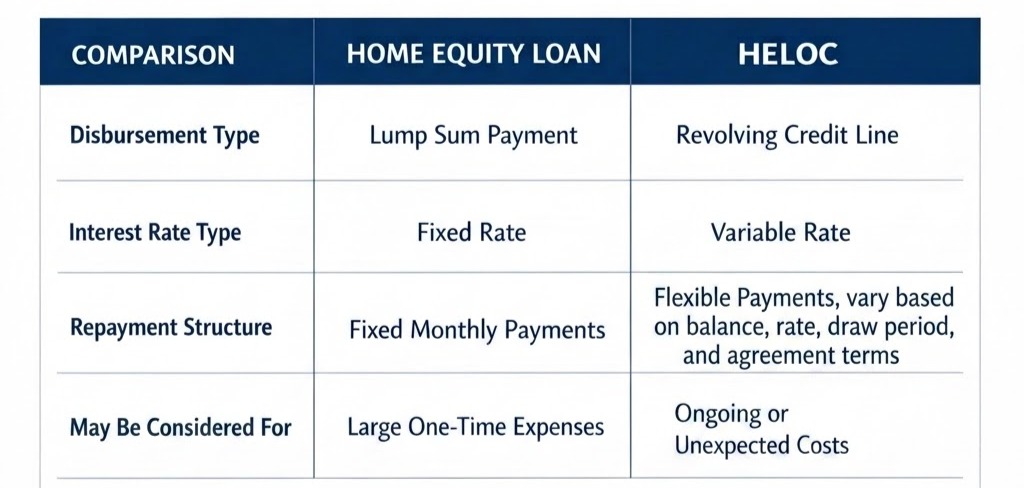
Home equity loan vs. HELOC is one of the main decisions homeowners face.
Both options let eligible homeowners borrow against equity. The difference is how funds are accessed and how repayment works.
Fixed Lump Sum vs Revolving Credit Line
A home equity loan provides funds as a lump sum. The borrower receives the loan proceeds at closing and repays the loan over a set term.
A HELOC, or home equity line of credit, works more like a revolving credit line. The borrower may draw funds as needed during the draw period, up to the approved limit. Repayment terms depend on the HELOC agreement.
A home equity loan may fit a single project with a known cost. A HELOC may fit ongoing work, phased renovations, or expenses that are harder to predict.
Interest Rate Differences: Fixed vs Variable
A home equity loan often has a fixed interest rate. That means the rate and payment structure are more predictable.
A HELOC often has a variable interest rate. That means the rate may change over time. If rates rise, the payment may also rise.
Borrowers should understand the rate structure before signing. They should also ask how payments may change, when the draw period ends, and what happens during the repayment period.
Which Option Fits Your Situation
The right option depends on the borrower’s goal.
A homeowner may prefer a home equity loan when the cost is known, the project is one-time, and payment predictability matters.
A homeowner may prefer a HELOC when flexibility matters and funds will be needed over time.
At a customer’s request, Springs Valley’s lending team may explain available product features, eligibility requirements, and repayment structures so the customer can evaluate which option may be appropriate for their circumstances.
How Much Home Equity May a Homeowner Be Able to Borrow?
How much home equity you may borrow depends on lender guidelines and the borrower’s financial profile.
Even when a homeowner has equity, the lender will evaluate the applicant’s creditworthiness and repayment ability under applicable law, Bank policy, and underwriting requirements.
Loan-to-Value for Home Equity Loan
For a home equity loan, loan-to-value generally compares the proposed home equity loan balance with the property value used by the lender. When the property is already subject to another mortgage or lien, the lender may also calculate combined loan-to-value by comparing the total applicable debt secured by the property with the property value used for underwriting.
This review helps protect both the lender and the borrower. It reduces the risk of borrowing too much against the property.
Homeowners should ask their lender how the calculation works and what limits may apply.
Lender Requirements and Equity Thresholds
Lender requirements may vary by loan type, property, credit profile, and market conditions.
Common review items include:
- Home value
- Mortgage balance
- Property type
- Credit history
- Income
- Debt obligations
- Employment or income stability
- Insurance
- Appraisal results
The lender may also review title, property condition, and whether the home meets loan requirements.
Rural properties may require special attention because comparable sales may be limited. Land size, buildings, and property use may affect the review.
All loan programs are subject to credit approval, underwriting requirements, and program eligibility. Not all applicants will qualify. Terms, conditions, and availability may vary based on borrower qualifications and property characteristics. Property insurance is required on property securing a home equity loan or HELOC. Flood insurance may also be required when applicable.
Credit Score and Income Considerations
Credit score and income are important because home equity borrowing still creates debt.
The lender needs to confirm that the borrower can manage payments. That review may include income documents, debt levels, payment history, and overall credit behavior.
Credit history and other underwriting factors may affect eligibility, pricing, credit limits, loan amounts, or other terms. The effect of those factors varies by product and applicant.
Borrowers should be honest about their budget before applying. The question is not only whether they may qualify. It is whether the loan fits their financial life.
Dangers of Home Equity Loans
The dangers of home equity loans should be taken seriously.
Home equity borrowing can be useful, but it is not risk-free. The biggest risk is that the home secures the loan.
The Home Serves as Collateral
With a home equity loan or HELOC, the home is collateral. If the borrower fails to meet the repayment obligations, the lender may exercise remedies available under the loan documents and applicable law, which may include foreclosure and loss of the home.
That risk is why home equity should be used with care.
Borrowers should review their income, emergency savings, job stability, and other debt before moving forward. They should also understand payment terms before closing.
Overborrowing and Negative Equity
Overborrowing happens when a homeowner borrows more than they can reasonably repay or uses too much available equity.
Negative equity can happen when the total debt secured by the home becomes higher than the home’s value. This can be especially stressful if the homeowner needs to sell, refinance, or respond to a financial hardship.
Homeowners should avoid borrowing just because equity is available. The loan should have a clear purpose and a manageable repayment plan.
How to Borrow Responsibly
Responsible borrowing starts with a clear reason.
Before applying, homeowners should ask:
- What is the purpose of the loan?
- Is the expense necessary?
- Is there a lower-risk option?
- Can the payment fit the household budget?
- What happens if income changes?
- Does the loan support long-term financial health?
Springs Valley’s lenders may, as requested, help homeowners review options and understand repayment expectations.
Using Home Equity for Rural Property Projects
Using home equity for rural property may look different from borrowing against a home in a larger metro area.
Rural homes may include acreage, barns, sheds, workshops, gravel drives, fencing, wells, septic systems, or agricultural buildings. Those features may affect appraisal and loan review.
Farm Improvements and Outbuilding Projects
Some homeowners use equity for rural property improvements such as fencing, outbuildings, drainage, driveways, equipment storage, or home repairs.
Farm families and property owners may also need to think about how improvements support long-term use of the land.
When a project is tied to farm or business activity, borrowers should ask whether a personal home equity product or a business lending option is more appropriate.
For projects tied to farm or business activity, customers may also ask whether agricultural financing or a commercial business loan is more appropriate.
All business loans and lines of credit are subject to credit approval. Terms and conditions vary by applicant and loan structure.
Why Local Appraisals Matter in Rural Indiana
Local appraisals matter because rural property may be hard to compare.
A home with acreage may not compare neatly with a home on a small lot. Outbuildings, land quality, location, access, and property use may all affect value.
A lender familiar with rural southwest Indiana may help explain why appraisal results may differ from an online estimate.
That local understanding may help borrowers set realistic expectations before applying.
How to Apply for a Home Equity Loan
Learning how to apply for a home equity loan may help homeowners prepare before they contact a lender.
Depending on the product and circumstances, the process may include an initial discussion, application, supporting documentation, credit and property review, valuation or appraisal, an underwriting decision, and, if approved and accepted, closing and funding.
Documents Borrowers May Need
Borrowers may need to provide the following:
- Government-issued photo ID
- Income documents
- Mortgage statement
- Homeowners insurance information
- Property tax information
- Employment or income details
- Debt information
- Project estimates, when applicable
Additional documents may be requested based on the borrower’s situation or the property type.
Being prepared may help the process move more smoothly.
The Application and Appraisal Process
The lender reviews the application and supporting documents. The lender may obtain an appraisal or other property valuation, depending on the transaction, property, applicable requirements, and Bank policy.
The appraisal helps determine the home’s value for lending purposes. The lender then reviews equity, credit, income, debt, and loan terms.
If the application is approved and the applicant chooses to proceed, the applicant will receive applicable disclosures and closing documents describing the final loan or line terms, repayment obligations, costs, and consumer rights.
Borrowers should read documents carefully and ask questions before signing.
Working With Springs Valley’s Lending Team
At a customer’s request, Springs Valley’s lending team may explain the features, application requirements, repayment structures, and potential risks of available home equity loans and HELOCs.
Customers can contact Springs Valley Bank & Trust, visit any Springs Valley branch, or review online resources before applying.
For homeowners asking how to use home equity, the best answer is careful planning. Home equity may help fund meaningful goals, but it should be used with a clear purpose, a manageable repayment plan, and a full understanding that the home secures the loan.
Contact Springs Valley Bank & Trust to speak with a local lending team member about home equity loans, HELOCs, and smart borrowing options.
Springs Valley Bank & Trust Company is an Equal Housing Lender and Member FDIC. Bank NMLS 412076.
This content is for informational purposes only and does not constitute financial, tax, or legal advice. Consult your own advisors regarding your individual situation.
All loans and lines of credit are subject to credit approval, underwriting requirements, program eligibility, and applicable terms and conditions. Product availability, loan or credit amount, rates, fees, and repayment terms may vary based on applicant qualifications, property characteristics, collateral, and other underwriting factors.
FAQs
How to Use Home Equity for Home Improvements?
Using home equity for home improvements may help fund repairs, renovations, accessibility updates, or rural property improvements.
A home equity loan may fit a one-time project with a defined cost. A HELOC may fit work that happens in stages. Springs Valley’s lending team can help homeowners compare both options and understand which may fit the project.
What is the Difference Between a Home Equity Loan and a HELOC?
A home equity loan provides a lump sum that is repaid over a set term.
A HELOC is a revolving credit line that allows the borrower to draw funds as needed during the draw period, up to the approved limit.
A home equity loan often provides more payment predictability. A HELOC often provides more flexibility, but the rate may vary.
How is Home Equity Calculated?
Home equity is estimated by subtracting the outstanding mortgage balance from the home’s current market value.
The lender may require an appraisal to determine the value used for loan review. The amount a homeowner may borrow depends on lender guidelines, credit, income, existing debt, property value, and loan terms.
Can Home Equity Be Used to Pay Off Debt?
Yes, home equity may be used for debt consolidation when the borrower qualifies.
This should be done carefully. The borrower is converting other debt into debt secured by the home. If repayment becomes difficult, the home may be at risk.
A clear repayment plan is essential.
What Are the Risks of Using Home Equity?
The main risk is that the home is collateral.
Other risks include borrowing more than the household can afford, variable rate changes on HELOCs, fees and closing costs, lower home value, and using equity for expenses that do not support long-term financial health.
Borrowers should review loan terms and budget carefully before applying.
How Much Equity is Needed Before a Homeowner Can Borrow?
The amount of equity needed depends on lender guidelines, the property value, the current mortgage balance, the credit profile, income, and debt obligations.
Lenders may limit borrowing based on loan-to-value or combined loan-to-value requirements, which may result in the homeowner retaining equity in the property after the transaction. Requirements vary by lender, product, property, and applicant qualifications. Springs Valley’s lending team can explain current requirements and help homeowners understand the application process.
Is Home Equity Interest Tax Deductible?
Interest paid on a home equity loan or HELOC may be deductible when the proceeds are used to buy, build, or substantially improve the qualified home securing the debt, subject to applicable IRS requirements and limitations. Interest attributable to funds used for personal expenses, such as credit card debt, generally is not deductible as home mortgage interest. Tax laws and individual circumstances vary. Consult a qualified tax professional regarding your situation.
Can Home Equity Be Used for a Rural Property Project or Farm Improvement?
Home equity financing may be available for certain rural property projects, subject to credit approval, property eligibility, acceptable collateral, appraisal or valuation results, and product requirements.
If a project is connected to agricultural or business activity, the customer should discuss the purpose and property use with the Bank so available consumer, agricultural, or commercial financing options can be considered.
All business loans and lines of credit are subject to credit approval. Terms and conditions vary by applicant and loan structure.
Homeowners asking how to use home equity should start with the purpose, the repayment plan, and the risk. Springs Valley Bank & Trust may, as requested, help customers review home equity loans and HELOCs with local guidance from a team that understands rural property needs.